
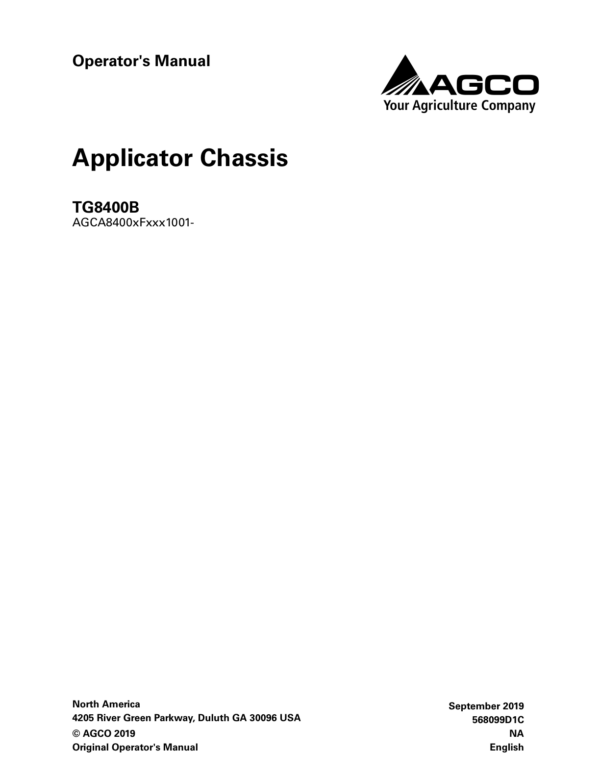
Ag-Chem TG8400B Flotation Chassis Operators Manual (FXXX1001 and later)
$22.00
Manual Included:
- Operators Manual: 298 Pages
Specifications:
- Brand: Ag-Chem
- Model: TG8400B
- Type: Flotation Chassis
- Manuals: Operators Manual
- Publication Numbers: 568099D1
- Serial: FXXX1001 and later
- Language: English
- Format: PDF
- Description
- Reviews (0)
Description
Table of Contents:
- 1. Safety
- 1.1 A word to the operator
- 1.1.1 Important safety information
- 1.1.2 Safety symbol
- 1.1.3 Safety messages
- 1.1.4 Information messages
- 1.1.5 General hazard information
- 1.2 Prepare for operation
- 1.2.1 Mount and dismount the machine
- 1.2.2 Before you start the engine
- 1.2.3 Start the engine
- 1.2.4 Before operating the machine
- 1.2.5 Operate the machine
- 1.2.6 Operator station
- 1.2.7 Park the machine
- 1.2.8 Exit the cab in an emergency
- 1.2.9 Safety lamps and marking devices use
- 1.2.10 Roading on public roads
- 1.2.11 Operate on a slope
- 1.2.12 Electrical storm injury prevention
- 1.3 Maintenance and service
- 1.3.1 Maintenance safety
- 1.3.2 Wear protective clothing
- 1.3.3 Fire prevention and first aid
- 1.3.4 Proper disposal of waste
- 1.3.5 Shield and guards
- 1.3.6 Support the machine correctly
- 1.3.7 Asbestos information
- 1.3.8 Pressurized air
- 1.3.9 Cut and crush prevention
- 1.3.10 Boom safety
- 1.3.11 Fuel safety
- 1.3.12 Hydraulic safety
- 1.3.13 High pressure leaks
- 1.3.14 Chemical safety
- 1.3.15 Engine safety
- 1.3.16 Battery safety
- 1.3.17 Tire safety
- 1.3.18 Avoid eye contact with radar
- 1.3.19 Exhaust fumes
- 1.3.20 Electrical power lines overhead
- 1.3.21 Towing
- 1.3.22 Modifications
- 1.3.23 Mobile radio installation
- 1.3.24 Safety signs
- 1.4 Safety signs
- 1.4.1 Overhead electrical power lines
- 1.4.2 Starter bypass
- 1.5 Cab safety signs
- 1.5.1 Operator's manual
- 1.5.2 Park brake
- 1.5.3 Bystander alert
- 1.5.4 Crushing hazard
- 1.5.5 Fall off hazard
- 1.5.6 Seatbelt
- 1.5.7 No passengers
- 1.6 Chassis safety signs
- 1.6.1 Hot pressurized coolant
- 1.6.2 Rotating blades
- 1.6.3 High pressurized fluid
- 1.6.4 Ether
- 1.6.5 Belt entanglement
- 1.6.6 Electrocution hazard
- 1.6.7 Radar
- 1.6.8 Crushing hazard
- 1.7 Informational signs
- 1.7.1 Informational – Tiedown
- 1.7.2 Ultra low sulfur diesel fuel
- 1.7.3 Informational – Cab filter #1
- 1.7.4 Informational – Hand wash
- 1.7.5 Informational – Battery shut off
- 1.7.6 Informational – Battery terminals
- 1.7.7 Informational – Cab filter #3
- 1.7.8 Informational – Cab filter #2 and washer bottle
- 1.7.9 Informational – Manufacturer plate
- 1.7.10 Informational – Alternate exit
- 1.7.11 Informational – Outlet voltage and maximum amperage
- 1.7.12 Informational – Hydraulic oil level
- 1.7.13 Informational – Do not alter
- 1.8 Informational electrical signs
- 1.8.1 Informational – Power distribution module
- 1.8.2 Informational – Upper electrical panel
- 1.8.3 Informational – Lower electrical panel
- 1.8.4 Informational – Chassis electrical panel
- 2. Introduction
- 2.1 Information
- 2.1.1 Intended use
- 2.1.2 Proper disposal of waste
- 2.1.3 Emissions reduction – selective catalyst reduction – SCR – technology
- 2.1.4 DEF Storage and Shelf Life
- 2.2 Machine identification
- 2.2.1 Product identification information
- 2.2.2 Serial number definition
- 2.2.3 Engine serial number plate
- 2.2.4 Transmission serial number plate
- 2.3 Break-in period
- 2.3.1 General break-in information
- 2.3.2 Break-in maintenance schedule
- 2.3.3 Operate the engine-first 200 hours
- 2.3.4 Initial interval for inline fuel strainer
- 2.3.5 Break-in the transmission
- 2.3.6 Break-in the rear axle
- 2.3.7 Do a check of the wheel mounting hardware
- 2.3.8 Hydraulic filter
- 2.3.9 Initial pressure washer pump
- 2.3.10 Initial engine valve adjustment
- 2.4 Machine transport
- 2.4.1 Operate the machine in limp-home mode
- 2.4.2 Transport the machine on a truck or trailer
- 2.4.3 Towing information
- 2.4.3.1 Prepare for towing – engine operation
- 2.4.3.2 Preparing for towing – engine not operating
- 2.4.3.3 Tow the machine
- 2.5 Park brake information
- 2.5.1 Release the manual park brake
- 2.5.2 Release the park brake using air
- 2.5.3 Release the park brake by manually releasing the spring
- 2.6 Major components
- 2.6.1 Component location (front/rear view)
- 2.6.2 Component location (side view)
- 2.6.3 Component location (top view)
- 2.7 Emissions warranty
- 3. Operation
- 3.1 Cab temperature control
- 3.1.1 Automatic temperature control
- 3.1.2 Heater operation
- 3.1.3 Defroster operation
- 3.1.4 Air conditioner operation
- 3.1.5 Automatic fan speed control
- 3.1.6 Manual fan speed control (HI/LO)
- 3.1.7 Air conditioning compressor clutch control
- 3.1.8 Heater water valve
- 3.1.9 Cab air temperature sensor
- 3.1.10 Evaporator probe
- 3.1.11 Temperature control troubleshooting
- 3.2 Controls and instruments
- 3.2.1 Inside cab components
- 3.2.2 Light switches for machine lights
- 3.2.3 Seatbelt operation
- 3.2.4 Basic operator seat
- 3.2.5 Deluxe operator seat
- 3.2.6 Deluxe vented operator seat
- 3.2.7 Instructor seat
- 3.2.8 Armrest controls
- 3.2.9 Joystick controls
- 3.2.10 Instrument cluster
- 3.2.11 Steering wheel controls
- 3.2.11.1 Power shuttle and shuttle lock
- 3.2.11.2 Shuttle shifting
- 3.2.12 Foot pedals
- 3.2.13 Telemetry (if equipped)
- 3.2.14 Monitor/Camera (if equipped)
- 3.2.15 Battery disconnect switch
- 3.2.16 DOT matrix display screens
- 3.2.17 DOT matrix display screen operation
- 3.2.18 Changing speed readout units
- 3.2.19 Reset the maintenance indicator lamp and the service hourmeter
- 3.2.20 Alarm – for future use
- 3.2.21 Application rate controller options
- 3.2.22 Slingshot ready – if equipped
- 3.3 Tag axle operation
- 3.3.1 Tag axle
- 3.3.2 Operate the tag axle
- 3.4 Prepare to start the engine
- 3.4.1 Do a check of the engine before starting
- 3.4.2 Engine power limitations
- 3.4.3 Low DEF level
- 3.4.4 SCR system malfunction
- 3.4.5 Start the engine
- 3.4.6 Cold temperature starting
- 3.4.7 Stalled engine – restart
- 3.4.8 Stop the engine and afterrun
- 3.4.9 Using the engine throttle control switches
- 3.4.9.1 Remote throttle preset
- 3.4.9.2 Location of the remote throttle control
- 3.4.9.3 Remote throttle controls
- 3.5 Operate on a public road
- 3.5.1 Machine operation on a public road
- 3.6 Transmission function
- 3.6.1 Transmission – general
- 3.6.2 Set the preset start up speeds
- 3.6.3 High and low speed range
- 3.6.4 Engine underspeed supervisor
- 3.6.5 Joystick mode
- 3.6.6 Foot pedal throttle mode
- 3.6.7 Machine management system
- 3.7 Calibration
- 3.7.1 Machine calibration
- 3.7.2 Inputting at level 1 – Cal 2
- 3.7.3 Calibrate the joystick handle
- 3.7.4 Calibrate the clutch
- 3.7.5 Calibrate the foot pedal throttle
- 3.7.6 Clear the DCC3 dash cluster error code
- 3.7.7 Clear the Auto4 transmission controller error code
- 3.7.8 Inputting at level 1 – Cal 1
- 3.7.9 Calibrate the hare and tortoise range
- 3.7.10 Calibrate the transmission
- 3.7.11 Calibrate the coupler function
- 3.7.12 Calibrate the radar
- 3.7.13 Calibrate the speed
- 3.8 Cold weather considerations
- 3.8.1 Minimize the effect of cold weather
- 3.8.2 Using grade No. 1-D fuel
- 3.8.3 Fuel filters
- 3.8.4 Coolant heater
- 3.8.5 Seasonal viscosity oil and proper coolant concentration
- 3.8.6 Winterfronts
- 3.8.7 Idling the engine
- 3.8.8 Engine coolant specifications
- 3.8.9 Cooling system water quality
- 3.8.10 Antifreeze
- 3.8.11 Grease
- 3.8.12 Diesel fuel
- 3.8.13 Lubricity of diesel fuels
- 3.8.14 Diesel fuel storage
- 3.8.15 Fuel tank information
- 3.9 Storage
- 3.9.1 Prepare for long term storage
- 3.9.2 Remove the machine from long term storage
- 4. Maintenance
- 4.1 Maintenance intervals
- 4.1.1 Maintenance introduction
- 4.1.2 Maintenance symbols
- 4.1.3 Lubricant filling reminders
- 4.1.4 Maintenance schedule
- 4.1.4.1 Daily maintenance schedule
- 4.1.4.2 Maintenance schedule 10 to 1000 hours
- 4.1.4.3 Maintenance Schedule 2000 to 4000 hours
- 4.1.5 Lubricants and fluids
- 4.2 Air dryer and conpressed air system
- 4.2.1 Air reservoir and air dryer
- 4.2.2 Air dryer
- 4.3 Air conditioner system
- 4.3.1 Air conditioner
- 4.3.2 Condenser
- 4.4 Engine
- 4.4.1 Do a check of the engine oil level
- 4.4.2 Change the engine oil and filter
- 4.4.3 Engine belts and tensioner
- 4.4.3.1 Replace the serpentine belt
- 4.4.3.2 Replace the water pump belt
- 4.4.4 Fuel system
- 4.4.5 Fuel tank
- 4.4.6 In-line fuel strainer
- 4.4.7 Replace the fuel filters
- 4.4.8 Prime the fuel system
- 4.4.9 Engine coolant
- 4.5 Maintaining the air cleaner
- 4.5.1 Engine air cleaner indicator
- 4.5.2 Replace the air filter element
- 4.5.3 Service the primary air filter
- 4.5.4 Secondary air filter element
- 4.6 Hydrailic system
- 4.6.1 Replace the hydraulic system oil and filter
- 4.7 Continouosly variable transmission
- 4.7.1 Transmission operating temperatures
- 4.7.2 Do a check of the transmission oil
- 4.7.3 Change the transmission oil
- 4.8 Transfer case assembly
- 4.8.1 Do a check of the transfer case oil
- 4.8.2 Change the transfer case oil
- 4.8.3 Clean the transfer case breather
- 4.9 Lubricate and inspect driveline and components
- 4.9.1 Lubricate the engine to the transmission driveline
- 4.9.2 Lubricate the transmission to the transfer case driveline
- 4.9.3 Lubricate the transfer case to rear axle driveline
- 4.9.4 Lubricate the front axle kingpins
- 4.9.5 Lubricate the front axle springs
- 4.9.6 Check the front axle mounting bolts
- 4.9.7 Lubricate rear axle springs
- 4.9.8 Check the rear axle mounting bolts
- 4.10 Intercoolers
- 4.10.1 Clean the heat exchangers
- 4.11 Front wheel and tag axle bearings
- 4.11.1 Front wheel bearing
- 4.11.1.1 Do a check of the front wheel bearing oil
- 4.11.1.2 Change the front wheel bearing oil
- 4.11.1.3 Wheel end oil change intervals and specifications
- 4.11.2 Tag axle bearing bolts and lubricating the tag axle fittings – if equipped
- 4.12 Steering
- 4.12.1 Steering cylinders
- 4.12.2 Do a check of the front wheel toe-in
- 4.12.2.1 Measure the front wheel toe-in
- 4.12.2.2 Adjust the front wheel toe-in
- 4.13 Rear axle
- 4.13.1 Clean the breather for the rear axle
- 4.13.2 Break-in the rear axle
- 4.13.3 Change the rear axle differential oil
- 4.13.4 Do a check of the rear axle oil
- 4.13.5 Change the rear axle planetary oil
- 4.14 Brake maintenance
- 4.14.1 Lubricate the front brake slack adjuster
- 4.14.2 Lubricate the rear brake slack adjuster
- 4.14.3 Brake air lines
- 4.14.4 Parking brake
- 4.14.5 Do a check of the service brake system
- 4.14.6 Do a check of the automatic slack adjusters
- 4.14.7 Manually adjusting the automatic slack adjusters
- 4.15 Wheels
- 4.15.1 Remove the wheels
- 4.15.2 Install the wheels
- 4.15.3 Tighten the wheel mounting hardware
- 4.16 Tires
- 4.16.1 Inflate the tire
- 4.16.2 Replace the tire
- 4.16.3 Tire charts
- 4.17 Cabin filters and windscreen wipers
- 4.17.1 Cab air filters and the windscreen washer reservoir
- 4.17.2 Cab air filters
- 4.17.2.1 Remove the primary fresh air filter
- 4.17.2.2 Install the primary fresh air filter
- 4.17.2.3 Remove the secondary fresh air filter
- 4.17.2.4 Install the secondary fresh air filter
- 4.17.2.5 Remove the recirculation air filter
- 4.17.2.6 Install the recirculation air filter
- 4.17.3 Maintain the cab air filter
- 4.17.3.1 Maintain the primary fresh air filter.
- 4.17.3.2 Maintain the secondary fresh air filter
- 4.17.3.3 Maintain the recirculation air filter
- 4.17.3.4 Clean the cab filter element
- 4.17.4 Windshield wiper blade
- 4.17.5 Fill the windscreen washer reservoir
- 4.18 Cab mounts
- 4.18.1 Do a check of the cab mounting bolts, rubber mounts, and air ride suspension
- 4.18.2 Do a check of the cab mounting bolts and rubber mounts
- 4.19 Electrical system
- 4.19.1 Batteries
- 4.19.1.1 Battery box components
- 4.19.1.2 Battery disconnect switch lever
- 4.19.1.3 Remove the battery terminal connection
- 4.19.2 Jump starting the battery
- 4.19.3 Locate the fuse panel
- 4.19.4 Fuse locations
- 4.20 Cab seat preventative maintenance
- 4.20.1 Lubricate seat adjusters
- 4.20.2 Armrest mechanism
- 4.21 Paint and decals
- 4.21.1 Safety treads
- 4.22 Application system
- 4.22.1 Application system installation
- 4.23 Hand rinse tank and pressure washer
- 4.23.1 Remove the hand rinse tank
- 4.23.2 Install the hand rinse tank
- 4.23.3 Pressure washer
- 4.23.3.1 Pressure washer input water supply
- 4.23.3.2 Before starting the pressure washer
- 4.23.3.3 Prime the pressure washer pump
- 4.23.3.4 General care of the pressure washer pump
- 4.23.3.5 Pressure washer pump storage in freezing conditions
- 4.23.3.6 Operate the pressure washer
- 4.23.3.7 Change the pressure washer pump motor oil
- 4.23.3.8 Change the pressure washer strainer
- 4.23.3.9 Winterize the pressure washer system
- 5. Troubleshooting
- 5.1 Engine
- 5.2 Transmission
- 5.3 Electrical system
- 5.4 Hydraulic system
- 5.5 Parking brake troubleshooting
- 5.6 Operation
- 5.7 Cab
- 5.8 Fault codes
- 5.8.1 Engine control system error and fault codes
- 5.8.2 Transmission error and fault codes
- 5.8.3 DCC3 error and fault codes
- 5.8.4 Chassis error and fault codes
- 6. Specifications
- 6.1 Machine specifications
- 6.2 Machine dimensions
Be the first to review “Ag-Chem TG8400B Flotation Chassis Operators Manual (FXXX1001 and later)”
You must be logged in to post a review.
Reviews
There are no reviews yet.